How to choose the best safety footwear according to your profession
Complete Guide for Mechanics, Logistics, Construction, Industry, and Electricians
Choosing good safety footwear goes far beyond complying with regulations. We spend many hours a day walking, standing, or working in environments where a poor choice can lead to fatigue, discomfort, and even accidents. Therefore, selecting the right footwear for your profession is one of the most important decisions for any worker.
Not all jobs require the same level of protection. A mechanic has different needs than an electrician, a logistics operator, or a construction professional. Knowing the characteristics that footwear should have in each case allows you to improve safety, comfort, and performance throughout the workday.
In this guide, we explain which type of safety footwear is most recommended for each profession and what aspects you should consider before buying it.
One of the most common mistakes is thinking that any safety shoe is suitable for any profession.
The reality is very different.
Each work environment presents specific risks:
- Impacts and falling objects.
- Electrical hazards.
- Slippery surfaces.
- Exposure to hydrocarbons.
- Humidity.
- High temperatures.
- Prolonged walking.
- Electrostatic discharges.
For this reason, footwear must be adapted to both regulations and actual working conditions.
Automotive workshops and centers demand comfortable, durable footwear with excellent grip.
A mechanic spends a large part of the day:
- Walking.
- Constantly bending over.
- Working on floors with oils or lubricants.
- Using heavy tools.
Recommended Features
✅ S1P or S3S Certification
✅ ESD Protection
✅ Hydrocarbon-resistant sole
✅ Lightweight and flexible design
✅ Excellent grip on smooth surfaces
✅ High comfort for long days
Currently, many professionals in the automotive sector opt for sporty models inspired by motorsport due to their comfort and lightness.
Logistics is one of the sectors where the most walking is done each day.
An operator can walk several kilometers during a workday.
Therefore, the weight of the footwear is a fundamental factor.
Recommended Features
✅ S1P or S3S Certification
✅ Lightweight fiberglass toecap
✅ Anti-perforation insole
✅ SR slip-resistant outsole
✅ High cushioning
✅ Breathable design
In this type of work, comfort is often as important as protection itself.
Construction is one of the most demanding environments in terms of workplace safety.
Working conditions often include:
- Uneven terrain.
- Humidity.
- Heavy materials.
- Debris.
- Risk of punctures.
Recommended features
✅ S3 or S3S certification
✅ Water-repellent upper
✅ Anti-perforation insole
✅ Impact-resistant toecap
✅ High-grip outsole
✅ Abrasion-resistant reinforcements
For construction and outdoor work, it is advisable to opt for robust models designed to withstand intensive use.
The industry encompasses a multitude of different sectors, from production and manufacturing to industrial maintenance.
For this reason, needs can vary depending on the activity.
However, there are common elements.
Recommended Features
✅ S3S Certification
✅ ESD Protection
✅ SR Slip Resistance
✅ Wear-resistant Materials
✅ High comfort for long shifts
✅ Oil and fuel resistant soles
In many modern industrial plants, ESD models have become practically standard.
Professionals working with electrical installations should pay special attention to antistatic and insulating properties.
Not all safety shoes are suitable for these types of tasks.
Recommended Features
✅ ESD protection according to the environment
✅ Insulating materials
✅ Non-metallic toecap
✅ Textile anti-perforation insole
✅ High comfort for precision work
✅ Reduced weight
In addition to protection, mobility and comfort are often essential for working safely.
Depending on the profession, these are the most common:
The evolution of the sector has led many workers to seek more comfortable and modern solutions.
The Sparco Teamwork range combines Sparco's experience in motorsports with the needs of today's work environment.
Its main advantages are:
- Motorsport-inspired designs.
- Reduced weight.
- High comfort.
- S1P, S3, and S3S versions.
- ESD models.
- Excellent balance between protection and comfort.
This has made Sparco one of the most recognized brands in the premium safety footwear sector.
What safety footwear is best for a mechanic?
S1P or S3S models with ESD certification and good hydrocarbon resistance are generally recommended.
What's the difference between S3 and S3S?
S3S is an evolution of the current standard that incorporates new puncture protection requirements.
Is a safety boot or a safety shoe better?
It depends on the job. Sneakers are generally more comfortable indoors, while boots offer greater protection outdoors.
What does ESD mean?
ESD refers to the footwear's ability to control and dissipate static electricity accumulated in the body.
When should I change my safety footwear?
When the sole shows significant wear, the toe cap has suffered impacts, or comfort noticeably decreases.
Other related articles
 Oct. 2, 2026
WHAT DO S1P, S3, S3S, AND ESD MEAN IN SAFETY FOOTWEAR? A COMPLETE GUIDE TO CHOOSING THE RIGHT FOOTWEAR
When buying safety footwear, it's common to encounter codes like S1P, S3, … June 11, 2026
Everything about Bell helmets: models, homologations, and advice for karting and racing
Bell Racing helmets are a global benchmark for safety and performance in … June 11, 2026
What are bucket seats and semi-bucket seats? A guide to choosing the ideal car seat
Bucket seats and semi-bucket seats are two types of sports seats designed …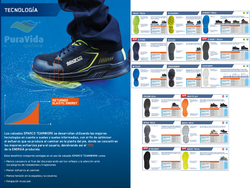 June 8, 2026
Sparco Teamwork sole guide: technologies, uses, and which one to choose for your work
Sparco Teamwork safety and professional footwear stands out not only for its …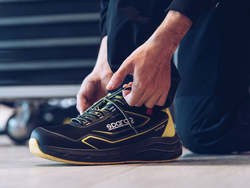 June 8, 2026
Receive our news